June 30, 2026 · Updated
5 Things Nobody Tells You Before Visiting San Blas
Five things surprise first-time visitors to San Blas: you are entering a self-governed indigenous territory with its own checkpoint and rules; you will see only a small western corner of several hundred islands; the sea, not the brochure, sets the route; the simplicity is a policy, not neglect; and money works in cash, outside the tour price.
Most guides stop at sunscreen and swimwear. What follows is the context that explains the trip once you are there.
1. You are crossing into a territory that governs itself
San Blas is the tourist name. The place itself is Guna Yala, a comarca: an indigenous territory whose people govern it through their own congresses, under a Fundamental Law they wrote themselves and that Panamanian law has recognized since 1953. You feel it before you see the sea. On the road down to the coast there is a checkpoint where foreigners show an original passport and every visitor pays the comarca’s entry tax: $22 for foreigners and $7 for Panamanian residents, with children under 10 exempt. It is not part of any tour price.
Inside the territory, each inhabited island has a local congress and a sagla, and their decisions apply to anyone present, visitors included. That is why a beach can be closed for a community event, why drones need permission and why you ask before photographing people. None of it is arbitrary; the Guna General Congress explained shows how the system works, and our Guna Yala overview puts it in context.
2. You will see a sliver of it
365 islands is the number on every brochure; the Guna General Congress itself speaks of more than 400 islands and islets, of which about 49 to 50 are inhabited communities. Panama’s 2023 census counted 32,016 people living in the comarca. The details are in how many islands does San Blas have.
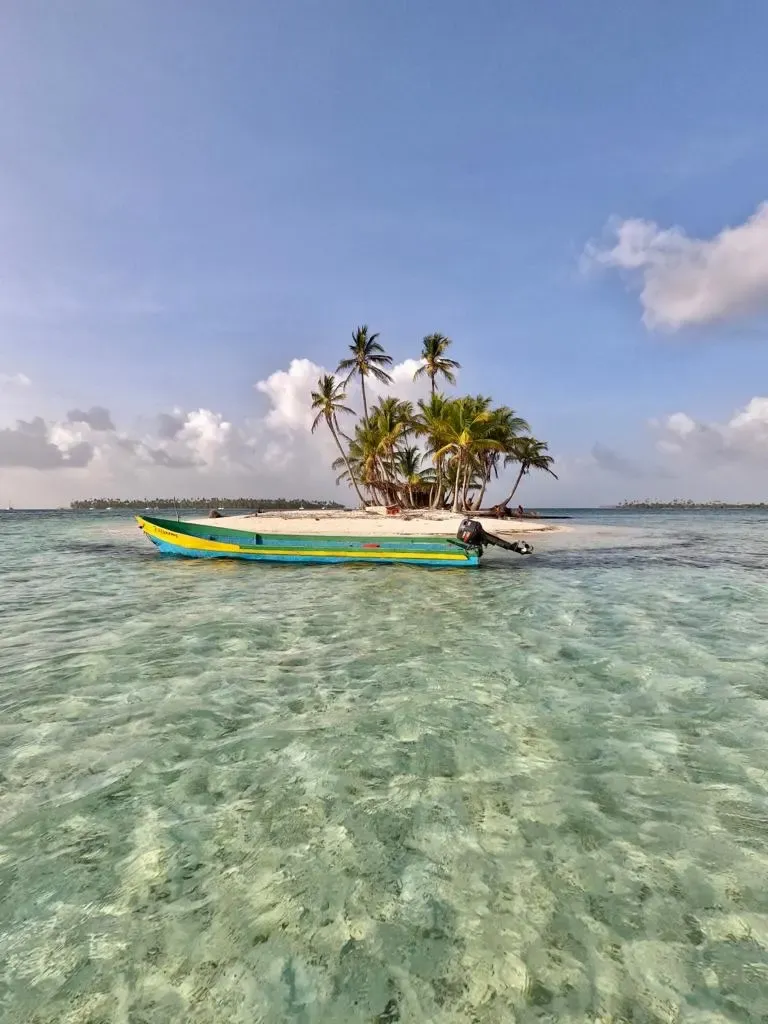
A visitor from Panama City, though, sees a handful. Boats leave from Cartí, at the western end of a coastline that runs for roughly 300 kilometres to the Colombian border, and most itineraries stay within reach of that port: the Cayos Limones, the cays around Isla Perro Chico, the Piscina Natural sandbar. The Cayos Holandeses are about as far out as a day goes. Everything east of that, including most of the inhabited communities, is a different trip entirely. Knowing this helps: you are choosing between a few well-known cays, described one by one in our islands guide, not between hundreds.
3. The sea writes the itinerary
Tour descriptions name islands, and that is useful as an indication. On the day, the captain decides. Wind, swell and the state of the channels determine which cays can be reached comfortably, and a stop can be swapped for a similar, more sheltered one. Experienced operators say so openly; anyone who promises a specific beach regardless of the weather is promising something no captain controls.
The same logic applies to comfort. A calm morning makes the crossing a smooth ride of 20 to 40 minutes; a breezy afternoon turns the open stretches into a bumpy, wet one. Pack as if you will get splashed, put your phone in a dry bag, and treat the route as part of the experience rather than a contract.
4. The simplicity is a rule, not a budget cut
People arrive expecting a Caribbean resort and find thatched cabins, shared bathrooms and little or no electricity. That is not a lack of investment. The Fundamental Law of Gunayala reserves all tourism activity in the territory to the Guna (Article 53), requires every tourism business to hold a written authorization from the General Congress, renewed every two years (Article 54), and instructs the Congress to limit both the number of tourist sites and the number of visitors in favour of small-scale, ecological tourism (Article 52). Land cannot be sold to outsiders, so there are no foreign hotel chains.
The result is the San Blas people come for: no high-rises, no jet skis, no loud bars. It also means no wifi, patchy mobile signal, little or no mains electricity on most islands and cold-water showers. If you are staying overnight, our guide to overnight stays describes each cabin type honestly, and our eco-tourism guide explains how the model works day to day.
5. Money runs on cash, and nothing is free for the taking
There are no ATMs anywhere in Guna Yala and no card terminals on the islands. Withdraw dollars in Panama City, in small bills, for the entry tax (unless you pay it by card to our driver), drinks beyond what is included, tips, and above all molas, the layered textile panels sold by the women who make them. Do you need cash in San Blas? breaks down what to carry for each kind of trip.
The less obvious part: almost every uninhabited cay is looked after by a Guna family, and its coconuts are that family’s harvest. Picking one up from the sand or knocking one down from a palm is taking someone’s income, not foraging. The same goes for shells, sea stars and anything else that looks unclaimed. Ask, buy, or leave it.
What people expect versus what they find
| What people expect | What they actually find |
|---|---|
| A resort island with services | Rustic cabins run by Guna families, by law and by choice |
| Choosing among 365 islands | A few cays near Cartí, chosen by the captain on the day |
| A national park with a ticket | An indigenous territory with its own checkpoint and tax |
| Paying by card | Cash only on the islands; the entry tax also by card to our driver |
| Staying connected | Patchy signal and no wifi; most people end up enjoying it |
None of this makes San Blas harder to enjoy. It makes it easier, because the things that frustrate visitors are almost always expectations imported from somewhere else.
Frequently asked questions
Do I need my passport to visit San Blas?
Yes. Foreigners show an original passport at the comarca checkpoint on the road in; a photocopy or a photo on your phone is not accepted. Panamanian residents show their ID to pay the resident rate of the entry tax.
Is the entry tax included in tour prices?
No. The $22 tax for foreigners ($7 for Panamanian residents, children under 10 exempt) is charged separately by the Guna authorities on the way in. It goes to the comarca, not to the tour operator.
Can I choose which islands I visit?
Only up to a point. You choose the itinerary, and the itinerary names islands, but the captain adapts the route to the wind and sea on the day. Treat published island names as a strong indication rather than a guarantee.
Why is there no wifi or electricity on the islands?
Because tourism in Guna Yala is deliberately small-scale and run by Guna families, not hotel chains. Most islands have little or no mains electricity and there is no wifi; a power bank and offline maps are the practical answer.
Can I pick up coconuts or shells on the beach?
No. Coconuts on the cays belong to the Guna families who look after them, and taking shells or sea stars harms the reefs. If you want a coconut, ask your hosts; they can usually sell or open one for you.
Ready to see it for yourself?
Message us on WhatsApp — a real person helps you plan, no contact form.
Book Now