April 5, 2026 · Updated
Molas Explained: How Guna Women Make Them, What They Mean and How to Buy One
A mola is a hand-sewn textile panel that Guna women make in pairs, for the front and back of their own blouses. It is built by reverse appliqué: several layers of coloured cotton are stacked, the top layers are cut away to expose the colours below, and every cut edge is folded under and stitched by hand. In Dulegaya, the Guna language, mola means both cloth and clothing.
What a mola is, and what the word means
The word does more work than its English use suggests. According to the Cleveland Museum of Art, which holds one of the larger mola collections outside Panama, “mola” in Dulegaya covers cloth in general, clothing, a single sewn panel and the finished blouse. When a visitor says “a mola”, they usually mean the rectangle of layered cloth. When a Guna woman says it, she may mean what she is wearing.
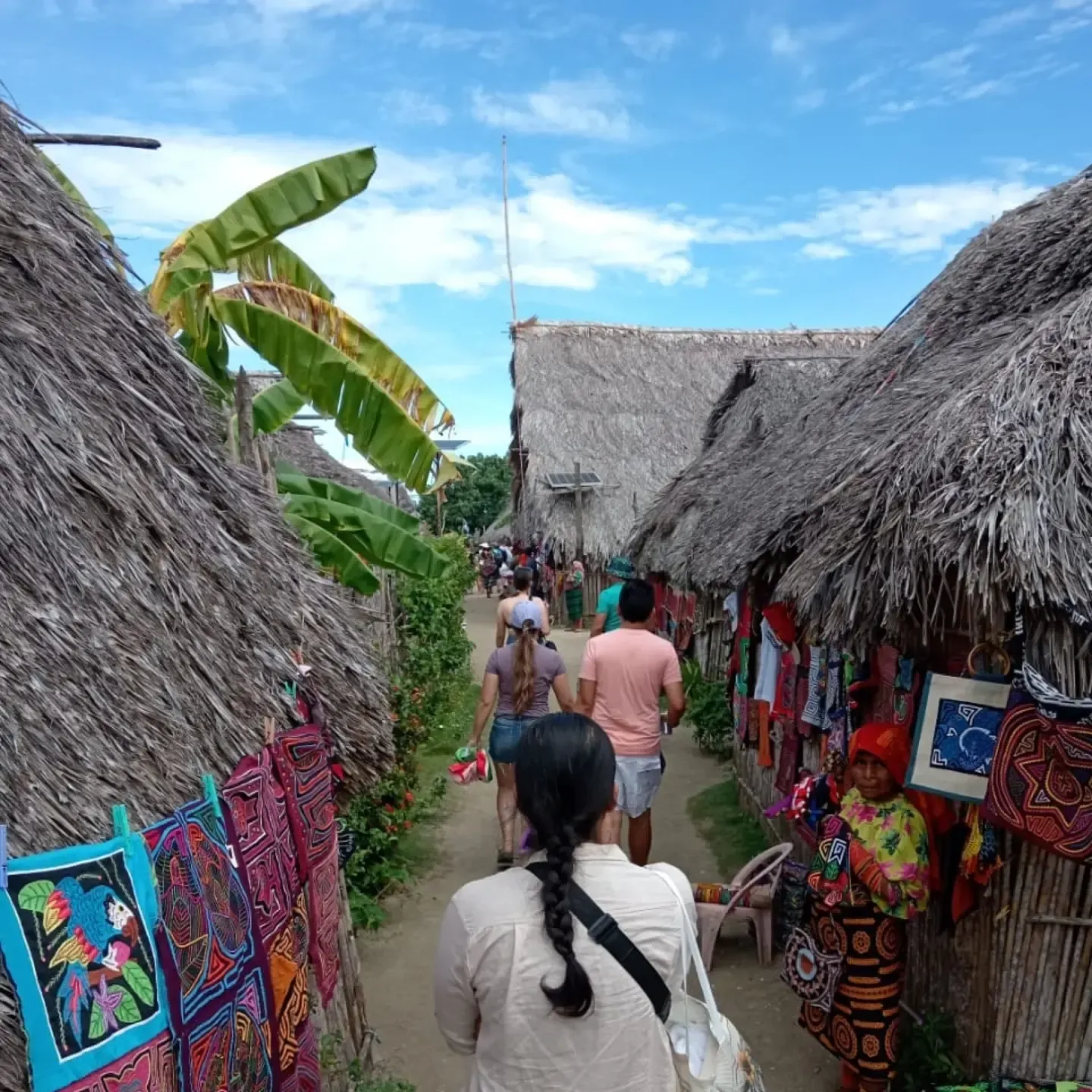
That blouse is one piece of a complete outfit. The two panels are joined to a yoke and sleeves of plain fabric, and the blouse is tucked into a printed wrap skirt. A red-and-yellow headscarf, long strands of beads wound around the forearms and calves, layered necklaces and, often, a small gold nose ring complete it. On the community islands of Guna Yala you will see this dress on women going about an ordinary day: at the dock, in the kitchen, at a meeting in the congress house.
How a mola is made, step by step
Nothing in a genuine mola is printed, and nothing is added by machine. The design is reached by removing cloth, not by drawing on it:
- Stack the layers. The maker chooses a base fabric and two or more contrasting colours, and tacks them together so they cannot slide.
- Cut the first shape. With small scissors she cuts a slit or outline through the top layer only, following a design she usually carries in her head rather than on paper.
- Turn the edge and stitch it. The raw edge is folded under a few millimetres and sewn down with tiny, nearly invisible stitches. This is the step that takes the time.
- Go deeper. Cutting through the next layer inside that opening exposes another colour, and the folding and stitching start again.
- Add detail. Small pieces of fabric are often sewn on top (ordinary appliqué), and embroidery adds eyes, outlines or texture.
| Technique | What it does | How to recognise it |
|---|---|---|
| Reverse appliqué | Cuts down through the layers to reveal colour beneath | Channels of colour with folded, stitched edges |
| Appliqué | Adds a small piece of cloth on top | A patch that sits slightly raised |
| Embroidery | Draws fine detail with thread | Lines too thin to be cut cloth |
Because every edge is turned and sewn by hand, a dense panel takes many days of work, and a complex one can take weeks. That is the honest explanation for the price differences you will see between two molas of the same size.
Where the mola came from
Molas are younger than many visitors assume. The Cleveland Museum of Art dates them to around the turn of the twentieth century, when imported cloth, thread, needles and blades made the technique possible. Commercial production began to grow in the 1960s, according to the Encyclopedia of World Cultures entry on the Guna, and molas have since been exported to the United States, Europe and Japan.
Being relatively recent does not make the mola less Guna. The opposite happened: within a couple of decades, this way of dressing became the clearest public sign of being Guna at all. It marks womanhood too: an interest in mola work is often how a community first recognises omeggid, Guna raised as boys who live as women.
Why a blouse became political in 1925
From 1918, under president Belisario Porras, the Panamanian government set out to assimilate the Guna. Police were stationed in island villages and suppressed customs that officials considered backward, women’s dress among them. Making and wearing molas turned into a quiet form of protest. In February 1925 the Guna rose up and forced the police out of the region — the uprising known as the Dule (or Tule) Revolution, which ended in an agreement recognising their right to keep their identity and run their own affairs.
That is why a mola is not neutral fabric in Guna Yala. It is the garment people were told to stop wearing, and did not. Our history of San Blas covers the revolution in full, and how the Guna General Congress works explains the self-government that came out of it.
Panamanian law now treats the mola as collective heritage. Law 20 of 2000 created a special intellectual-property regime for the collective rights of indigenous peoples, and the decree that implements it, Executive Decree 12 of 2001, lists the mola by name among the protected traditional creations.
What the designs show
There is no single code that unlocks every mola. Designs run from abstract, maze-like geometric patterns to animals, plants, scenes of island life, figures from Guna stories and objects from the world outside the comarca. Each maker works from her own repertoire and taste, which is why two panels are never the same and why asking the maker “what does this one show?” is a better question than looking it up.
Pairs are the exception that proves the rule: the front and back of one blouse are made to match, but even they differ in small details because each was cut by hand.
How to tell a hand-sewn mola from an imitation
Printed fabric with mola-style patterns is sold in Panama City and online. A few checks separate the two:
- Feel the edge of a colour channel. A real mola has a folded edge you can feel with a fingertip; a print is flat.
- Look at a corner. You should be able to see the stacked fabrics where the panel is finished.
- Turn it over. The back shows the stitching. Hand stitches are small and slightly uneven; a perfectly regular line is a machine.
- Compare the line widths. Hand-cut channels vary a little. Absolute uniformity is a warning sign, not a mark of quality.
How to buy a mola well
- Buy from the woman who made it, which on the islands is usually possible. There is no intermediary and the whole price stays with her household.
- Bring cash. There are no ATMs and no card terminals anywhere in the comarca; see how much cash to bring.
- Judge price by work, not size. More layers, finer channels and denser detail cost more. A panel far cheaper than the others around it usually reflects less work.
- Ask before photographing the maker or her table, as you would anywhere in Guna Yala.
- Give yourself time. A day stop leaves a few minutes at a seller’s table; a night on an inhabited island such as Nugnudub, or a visit to El Porvenir, leaves room for the conversation. Our Guna culture guide covers etiquette on inhabited islands.
Frequently asked questions
What does the word mola mean?
In Dulegaya, the Guna language, mola refers to cloth and clothing in general, and also to the sewn panel and the finished blouse. Visitors use it for the panel alone.
How long does it take to make a mola?
It depends on the number of layers and the density of the design. A simple panel takes days; a fine, many-layered one can take weeks, because every cut edge is folded and stitched by hand.
Are molas made for tourists?
No. They are first of all the blouse panels Guna women wear every day. Some are made to sell, using the same technique and the same hands, and selling them is an important source of income for many families.
How can I tell if a mola is genuine?
Look for folded edges you can feel, several fabric layers visible at a corner, and small, slightly irregular hand stitches on the back. A flat surface or perfectly even machine stitching means an imitation.
Why are molas linked to the 1925 revolution?
The Panamanian authorities tried to suppress Guna dress in the years before 1925, so wearing molas became an act of resistance. The revolution that followed secured the Guna right to keep their identity and govern their territory.
Can I photograph women wearing molas?
Only if you ask and they agree. Traditional dress is everyday clothing, not a costume, and a quick request is the whole protocol. If the answer is no, that is the end of it.
Ready to see it for yourself?
Message us on WhatsApp — a real person helps you plan, no contact form.
Book Now