May 11, 2026 · Updated
The Guna General Congress: How Guna Yala Actually Governs Itself
Guna Yala governs itself through two congresses of its own: the Guna General Congress, which handles political and administrative matters, and the General Congress of Guna Culture, which guards tradition and spirituality. Beneath them, every community has a local congress led by its sagla. Panamanian law has formally recognized this structure since 1953.
The rulebook: the Fundamental Law of Gunayala
Guna self-government is not a loose custom; it is written down. The rules sit in the Fundamental Law of Gunayala, called Gunayar Igardummadwala in Dulegaya, the Guna language. The version in force was approved by the congresses themselves in September 2013, at a session held in the community of Mirya Ubgigandub, and the General Congress publishes the full text on its official website.
That text sets out two highest authorities, each with its own job:
- The Guna General Congress (Onmaggeddummad Sunmaggaled) is the top political and administrative body. Its resolutions bind Guna authorities, national institutions and anyone present in Guna territory for any reason, visitors included. It meets in ordinary session every six months, and a session only counts if at least two thirds of the communities attend.
- The General Congress of Guna Culture (Onmaggeddummad Namaggaled) is the authority for spirituality and heritage. It protects history, sacred sites and the teaching of babigala, the Guna historical tradition, and it coordinates the election of the General Congress’s representatives.
Each congress has three sagladummagan, its legal representatives, usually called general chiefs in Spanish. The law asks a lot of them: they must be at least 45, of Guna origin, versed in babigala and fluent in both Dulegaya and Spanish.
There is no capital building where all this happens. The General Congress moves, meeting in a different community each time. According to its own website, in 2026 it held an ordinary assembly in Dubwala in late May, an extraordinary one in Urnaguedub in August, and called the next ordinary session in Dadnaggwe Dubbir for October.
In every community: the local congress and the sagla
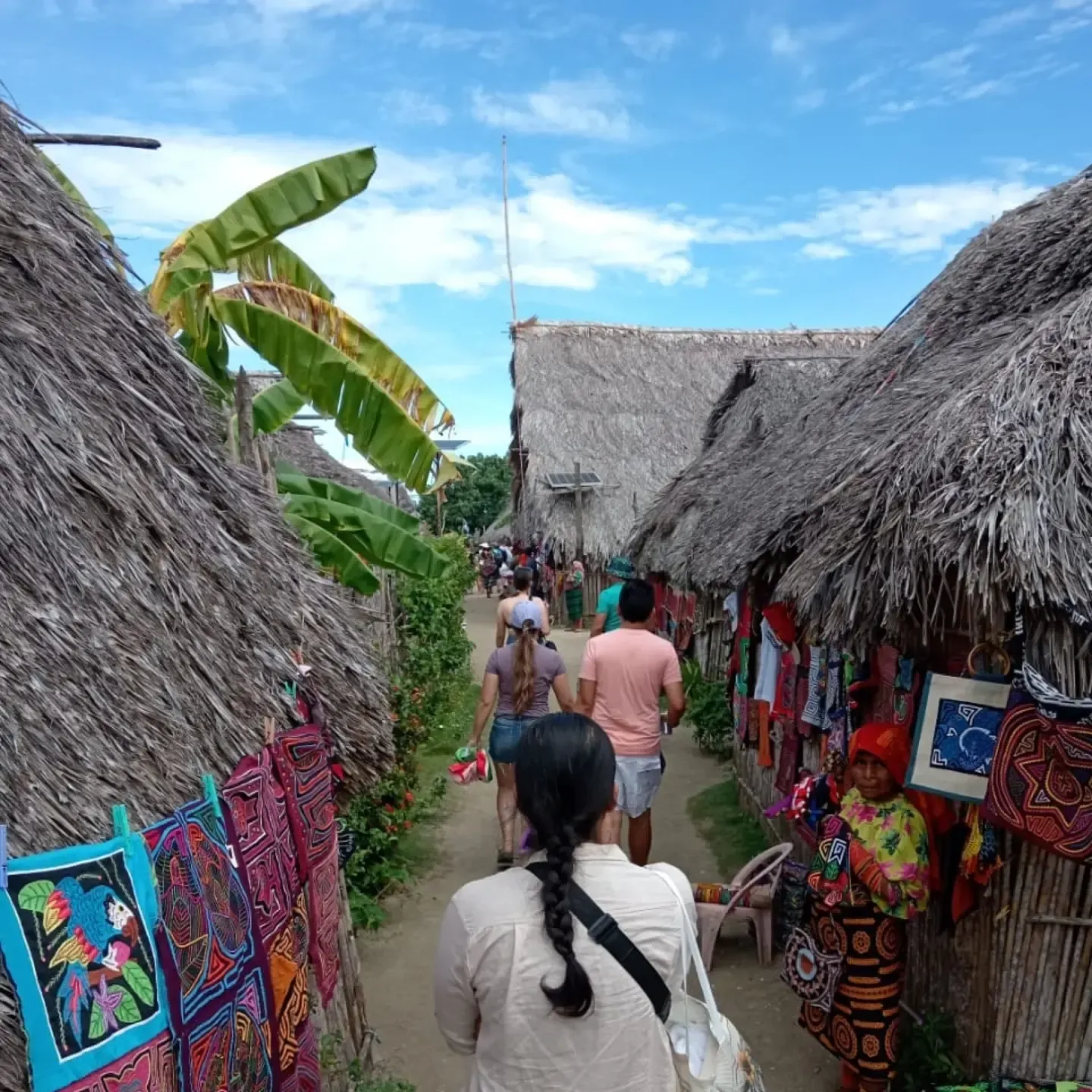
On each inhabited island the first authority is the local congress, which is open to the whole community and meets in the congress house, the onmaggednega. If your tour includes a community stop, this is the building where the island’s decisions are actually taken.
At its head is the sagla, whom the Fundamental Law describes as the principal authority in each community. A sagla is supported by other saglagan and chosen according to each place’s own traditional practice, so the process is not identical from island to island.
How that authority works in practice is explained from the inside in a September 2026 article in Cultural Survival, co-written by Iniquilipi Chiari-Lombardo, deputy secretary of the Guna General Congress. The saglas guide their communities through chants that carry ancestral knowledge, and the argar interpret those chants for present-day problems. The same article puts the number of communities linked by the General Congress at 49. When the General Congress votes, each community has one vote, and its sagla casts it.
A note on spelling: sagla is the current form. Older texts write sáhila or saila, which is how Panama’s 1953 law names the office. It is the same role.
Who does what, at a glance
| Body | Name in Dulegaya | What it decides |
|---|---|---|
| Guna General Congress | Onmaggeddummad Sunmaggaled | Political and administrative matters for the whole comarca |
| General Congress of Guna Culture | Onmaggeddummad Namaggaled | Spirituality, history, sacred sites, babigala |
| Local congress | meets in the onmaggednega | Daily life and rules of each community |
| Sagla | — | Leads the community and casts its vote at the General Congress |
The Panamanian laws that recognize it
The relationship with the Panamanian state was written down law by law:
- Law 2 of 16 September 1938 created the Comarca de San Blas, the territory’s first legal form.
- Law 16 of 19 February 1953 organized the comarca and is the key text. Its Article 13 recognizes the Guna General Congress and the village congresses, and Article 12 their jurisdiction, except in criminal matters. It made El Porvenir the seat, provided for an intendant as the state’s administrative authority and named three principal sáhilas based in Tubualá, Ustupu and Narganá. Article 21 already said that reserve land could not be granted to anyone outside the community without the approval of two congresses.
- Law 20 of 1957 declared the territory a reserve.
- Law 99 of 1998 and Law 536 of 2026 renamed it Kuna Yala and then Gunayala; the story behind each name is in what “Guna Yala” means.
The Guna stress one point about all of this: these laws recognized a self-government that already existed, and that the Guna had defended by force in 1925. The uprising and the peace agreement that followed are told in full in our history of San Blas.
What self-government changes for visitors
The Fundamental Law has a whole section on tourism, and it explains several things travelers notice without knowing where they come from:
- Tourism is limited on purpose. Article 52 instructs the Congress to cap both the number of tourist businesses and the number of visitors, citing the cultural impact of mass tourism, and to favor selective, sustainable and ecological tourism. The small scale of everything here is a decision, not a shortcoming.
- Tourism belongs to the Guna. Article 53 reserves all tourism activity in the comarca to the Guna, and Article 54 requires every business to hold written authorization from the Congress, renewed every two years. That is why your captain, cook and host are Guna.
- Land is not for sale. Article 33 declares the land inalienable: it cannot be sold or leased permanently. No outsider can buy an island, which is why there are no foreign resorts.
- Every for-profit activity contributes. Article 59 sets a contribution to the Congress. Visitors also pay an entry tax at the edge of the territory; where the community tax goes explains how it works.
- Each community decides about its own space. Filming, flying a drone or photographing people depends on the local authority, which is the practical reason behind the etiquette in our Guna culture guide.
So if a community closes a beach for the day or asks you not to do something, it is not arbitrary. It is a local authority using powers that Panamanian law and the Guna’s own law both recognize.
Frequently asked questions
Who governs Guna Yala?
Two congresses of its own: the Guna General Congress, which is political and administrative, and the General Congress of Guna Culture, which is spiritual and cultural. Each has three sagladummagan as legal representatives, and every community has its own local congress and its sagla.
What is a sagla or sáhila?
The principal authority of each Guna community, chosen according to that community’s traditional practice. The sagla guides the community, chairs its local congress and casts its vote at the General Congress. Sáhila and saila are older spellings of the same office.
Which law created the Guna Yala comarca?
Law 2 of 1938 created the Comarca de San Blas, and Law 16 of 1953 organized it and recognized the Guna General Congress. The name changed to Kuna Yala in 1998 and to Gunayala under Law 536 of 2026.
Can you buy an island in San Blas?
No. The Fundamental Law of Gunayala declares the land inalienable and collectively owned by the Guna people, and Law 16 of 1953 already barred granting it to outsiders without the approval of the congresses.
Ready to see it for yourself?
Message us on WhatsApp — a real person helps you plan, no contact form.
Book Now