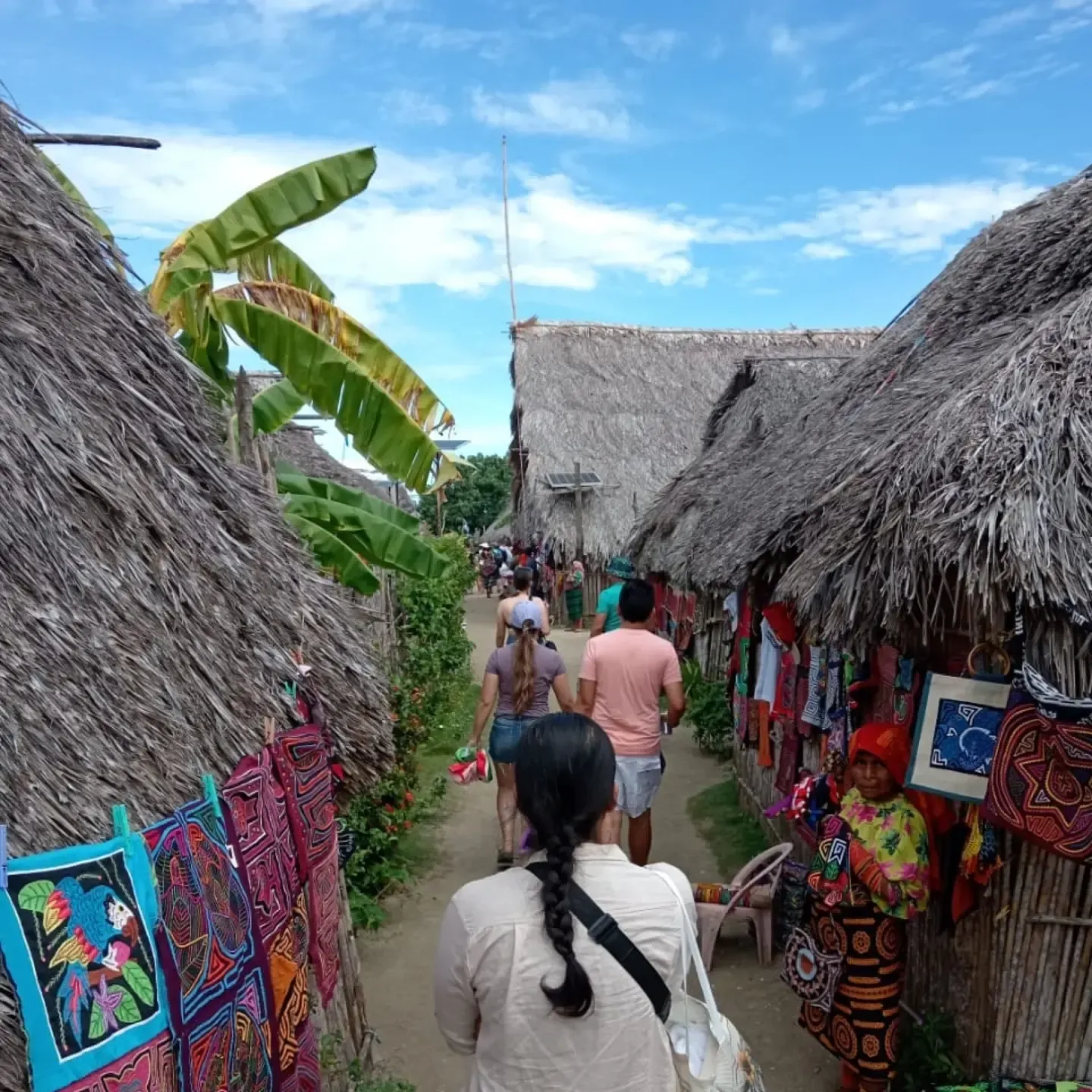
May 7, 2026 · Updated
What Does 'Guna Yala' Actually Mean?
“Guna Yala” means “territory of the Guna”: in Dulegaya, guna names the people and yala means mountain, territory or region. San Blas is the Spanish name Panama used when it created the comarca in 1938, Kuna Yala became official in 1998, and since June 2026 the law writes it as one word: Gunayala.
What the two words mean
The most reliable source for the meaning is the Guna–Spanish school dictionary published by the Guna General Congresses themselves. There, guna refers to a person of the Guna people, and yala is defined as “mountain; territory, region, comarca”. Put together, Gunayala is literally the territory of the Guna.
The same dictionary gives a related word worth knowing: Abiayala, the Dulegaya name for the whole American continent. And it records the word the Guna use for themselves: dule, defined simply as “person”.
So the name is not a poetic label invented for tourism. It is a plain, descriptive statement of whose land this is.
Three names, three eras
| Name | Dates from | Where it comes from |
|---|---|---|
| San Blas | 1938 (Law 2) | Spanish place names on outsiders’ maps |
| Kuna Yala | 1998 (Law 99) | The people’s own name, chosen by their congresses |
| Guna Yala | 2010 (Law 88) | Same name in the Guna alphabet; the legal name stayed Kuna Yala |
| Gunayala | 2026 (Law 536) | The legal name today, one word, as the General Congress writes it |
San Blas: a name from outside
San Blas is the name in the earliest laws. Law 2 of 16 September 1938 created the “Comarca de San Blas”, and Law 16 of 1953, which organized it, traces its borders using the Punta de San Blas and the Cordillera de San Blas, two landmarks that already carried the name. As late as May 1998, the law that made Dule Revolution Day a holiday still referred to the “Comarca de San Blas”.
There is no reliable source on who first gave the name or when, so we will not invent one. What is clear is that it is not a Guna name: it is Spanish and comes from outsiders’ maps.
It is also still the name almost all tourism uses, which is why this site carries it. It is what people search for, and Guna-run businesses use it too, alongside their own.
Kuna Yala: the people’s own name, from 1998
Law 99 of 23 December 1998 changed the official name to Comarca Kuna Yala. According to the congresses’ dictionary, the change was decided by the Guna congresses themselves and then ratified by Panamanian law. That order matters: the name came from the people, and the state followed. The same congress system is explained in the Guna General Congress explained.
From K to G: only the spelling changed
The switch from Kuna to Guna did not change how anyone speaks. Law 88 of 2010, published in Panama’s Official Gazette on 26 November that year, recognized the country’s Indigenous languages and set their alphabets. The Guna alphabet has fifteen letters: the five vowels plus b, d, g, l, m, n, r, s, w, y. There is no K.
The anthropologist James Howe explained the reasoning in an article in La Prensa in 2014. Dulegaya distinguishes single and double consonants, and the old spelling used P, T and K for all of them, blurring real differences. A committee of Guna scholars chose to write them as G and GG, B and BB, D and DD. The island of Tupile, for example, became Dubbile. Howe stresses that only the writing changed: the language and its sound stayed exactly the same.
The congresses’ dictionary sums it up in one rule: a consonant at the start of a word is never doubled, even when it sounds strong. You write guna and say something very close to “kuna”; you write dule and it sounds almost like “tule”. That is why visitors hear a K and read a G.
There are exceptions. Surnames with a long written history keep their old spelling, such as Kantule, the name of Nele Kantule, a leader of the 1925 Dule Revolution. And Law 88 itself, with its K-less alphabet, still calls the language “kuna”.
Gunayala, one word: the 2026 law
The latest change is very recent. The National Assembly passed bill 112 on 30 April 2025, at the request of Guna authorities and linguists. The executive objected in June because the bill forced every institution to switch names at once; the Assembly overrode the objection on 26 March 2026, and the measure became Law 536 of 18 June 2026, published the next day in Official Gazette no. 30550.
Its first article reads, in translation: “The Kuna Yala comarca is named Gunayala.” One word, with a G, as the dictionary and the General Congress write it. Article 2 asks the government to apply it “progressively”, so for a while you will see signs, maps and documents mixing Kuna Yala, Guna Yala and Gunayala.
One more detail avoids confusion: Gunayala is not Panama’s only Guna territory. The same dictionary lists the comarcas of Madungandi (Law 24 of 1996) and Wargandi (Law 34 of 2000).
Which name to use on your trip
- Guna Yala or Gunayala is correct today, and Gunayala is how the General Congress writes it in its own documents. Both forms are understood.
- San Blas is understood by everyone, in Panama City and on the islands. It works fine, as long as you know it is the outsiders’ name.
- Kuna with a K is the spelling from before the 2010 alphabet. You will find it in older books, maps and laws, but it is no longer the correct form.
Using the Guna name is a small, real sign of respect when you are a guest in a self-governed territory. Howe went a step further and suggested speaking of the dule, which is what the people call themselves. For the etiquette that follows from that, see our Guna culture guide.
Frequently asked questions
Are San Blas and Guna Yala the same place?
Yes. San Blas is the Spanish name Panama used when it created the comarca in 1938, and Guna Yala or Gunayala is the Guna people’s own name for their territory. Both refer to the same archipelago and the same strip of Caribbean coast.
Why is Kuna now spelled with a G?
Because of the Guna alphabet recognized by Law 88 of 2010, which has no K. Pronunciation did not change: at the start of a word the G sounds very close to a K, which is why you read guna and hear almost “kuna”.
What is the comarca’s official name today?
Gunayala, written as one word, since Law 536 of 18 June 2026. From 1998 it was Comarca Kuna Yala, and in its first laws, Comarca de San Blas.
What does the word “dule” mean?
It means “person”, and it is the word the Guna use for themselves, according to the Guna–Spanish dictionary of the General Congresses. James Howe suggested it as the most respectful way for outsiders to refer to the people.
Ready to see it for yourself?
Message us on WhatsApp — a real person helps you plan, no contact form.
Book Now